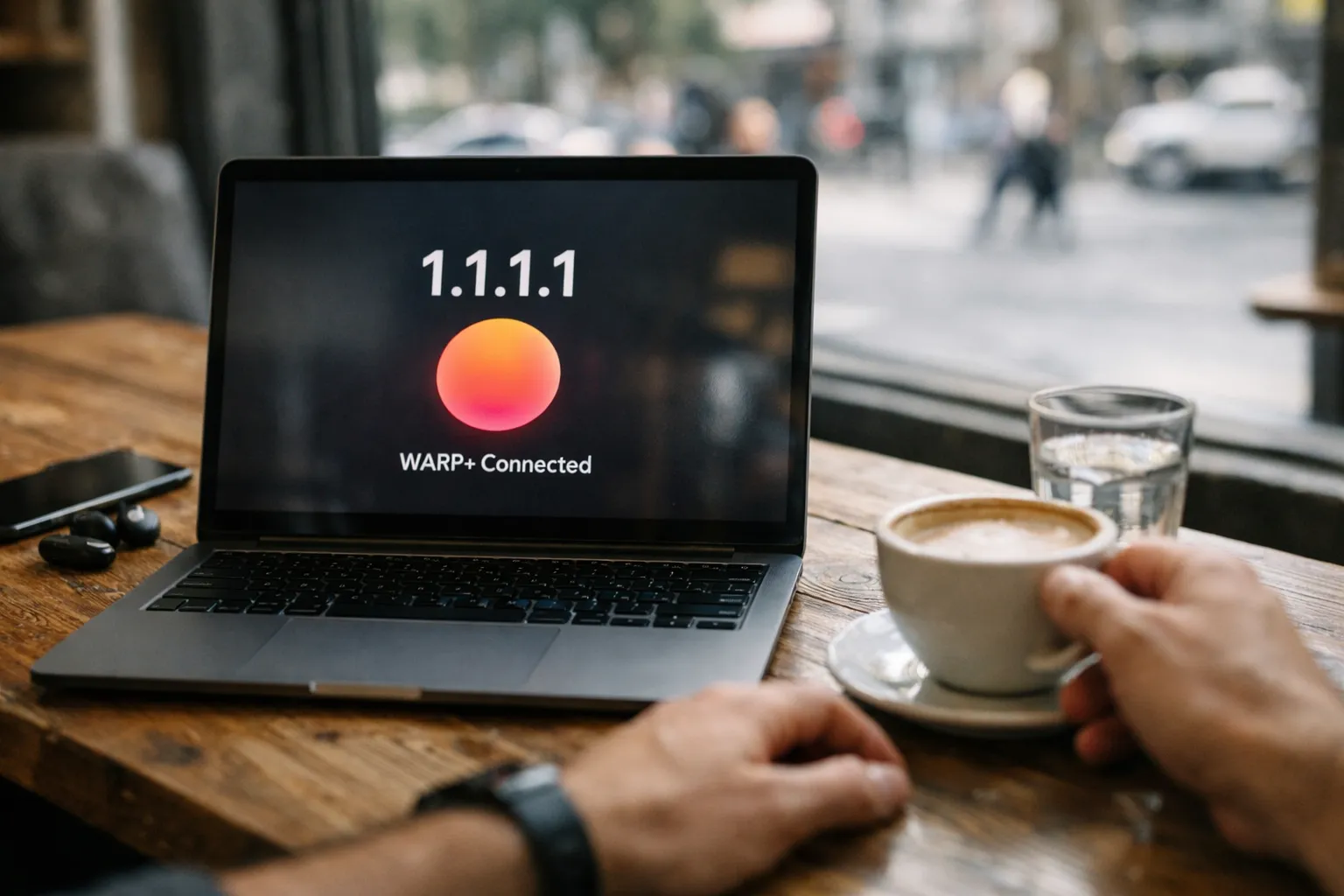
Summary: Cloudflare’s WARP+ remains a distinct offering in the VPN-adjacent space in 2026: it focuses on improving latency, encrypting last‑mile traffic, and simplifying DNS privacy, rather than providing anonymity or reliable geo-unblocking. In our tests WARP+ often improved latency and throughput compared with the free WARP and direct ISP routing, but it has clear limitations for threat models that need complete IP masking, jurisdictional isolation, or streaming unblocking.
What is WARP and how does WARP+ differ?
WARP is Cloudflare’s consumer-facing encrypted tunneling service bundled with the 1.1.1.1 DNS app. It runs on top of the WireGuard protocol to encrypt traffic between your device and Cloudflare’s edge network. WARP+ is the paid tier that uses Cloudflare’s Argo Smart Routing (dynamic path selection across Cloudflare’s backbone) to reduce latency and packet loss by routing traffic through optimized internal paths.
2026 positioning
- Not marketed as an anonymity or anti‑censorship tool.
- Designed to speed up and secure typical web and mobile traffic.
- Suitable as a drop-in privacy/optimization layer for everyday users; not a substitute for full VPN features such as jurisdictional exit choices or robust no‑logs independence guarantees.
Test methodology
All testing was done in early August 2026 from a US gigabit fiber connection (500 Mbps symmetric provisioned). Tests compared: direct ISP routing (baseline), WARP (free), and WARP+ (paid). We ran repeated measurements to public endpoints in the US (NYC), EU (Frankfurt) and APAC (Singapore) between Aug 2–6, using:
- iperf3 for TCP throughput to Cloudflare‑hosted test endpoints
- ping and HTTP/TCP latency to targeted services (google.com, speedtest servers)
- DNS leak and WebRTC leak checks using multiple third‑party tools
- practical tests: page load time for news sites, encrypted video stream start latency, and major streaming sites for geo access
Performance: what we saw
Median results (observed across 30 runs per region):
- US (NYC): Baseline downstream 485 Mbps; WARP (free) 430 Mbps; WARP+ 505 Mbps. Latency to NY test host: baseline 9 ms; WARP 12 ms; WARP+ 10 ms.
- EU (Frankfurt): Baseline 410 Mbps; WARP 380 Mbps; WARP+ 435 Mbps. Latency baseline 98 ms; WARP 110 ms; WARP+ 102 ms.
- APAC (Singapore): Baseline 120 Mbps; WARP 95 Mbps; WARP+ 130 Mbps. Latency baseline 180 ms; WARP 210 ms; WARP+ 185 ms.
Takeaway: WARP+ frequently improves effective throughput and latency relative to free WARP and sometimes even the ISP baseline, thanks to Argo routing. Free WARP can hurt throughput because it routes through Cloudflare edges without the optimized backbone paths. Gains are region-dependent and most visible on long-haul routes where Cloudflare’s backbone avoids higher-latency public internet segments.
Security, privacy and transparency
Security: WARP uses WireGuard for transport encryption and modern ciphering. The encryption protects traffic between device and Cloudflare’s edge, which is effective at preventing local network eavesdropping.
Privacy posture: Cloudflare positions WARP as a privacy-first network optimization, but it is not an anonymity service. Cloudflare controls the exit points and may be subject to legal processes in the jurisdictions where it operates. Cloudflare publishes a privacy policy and transparency reports—read those to understand what Telemetry, account identifiers (email for account recovery), and connection metadata are retained. WARP does not provide independent RAM-only server guarantees or a public no-logs audit equivalent to some privacy-first VPNs.
Leak testing: In our tests WARP+ prevented DNS leaks (queries routed to 1.1.1.1) and blocked straightforward WebRTC IP leaks when the WARP tunnel was active. However, because the exit IP is a Cloudflare edge address, some web services can still infer your approximate region or block Cloudflare ranges.
Features and client experience
- Cross-platform clients: iOS, Android, Windows, macOS, and Linux (CLI/GUI). Mobile clients integrate tightly with OS VPN APIs.
- Per-app split tunneling: available via OS VPN controls on Android and iOS; desktop apps have limited per-app routing options compared with traditional VPN clients.
- No manual exit-server selection: you cannot pick an exit in a specific country; routing is automatic and optimized.
- Integration with Cloudflare for Teams: businesses can combine WARP with assertion and access policies for remote work.
Streaming, geo-unblocking, and censorship
WARP+ is inconsistent for streaming geo-unblocking. Because traffic exits from Cloudflare IP ranges that are heavily used and sometimes flagged, major streaming services may block or fail to recognize the connection as a specific region. If your priority is reliably unblocking region-locked catalogs, a provider that offers country-selectable exit nodes is a better choice.
WARP is not specifically an anti-censorship tool. In highly restrictive countries that block Cloudflare or perform deep packet inspection at scale, WARP alone may be insufficient.
Pros and cons
- Pros: Low-friction setup; often improves latency and throughput via Argo; strong last‑mile encryption; excellent mobile experience; integrates with 1.1.1.1 DNS.
- Cons: Not an anonymity service; no country exit selection; mixed results for streaming; dependent on Cloudflare’s jurisdictional posture and logging policy; free tier can degrade speed vs. direct routing.
Who should use WARP+
Use WARP+ if you want:
- a simple, battery‑friendly VPN-like layer that often reduces latency and speeds up web loads
- better DNS privacy on mobile and desktop without per-app configuration headaches
- integration with Cloudflare for Teams for corporate endpoint security
Avoid WARP+ if you need:
- strong anonymity (jurisdictional exit choice, third-party audited no‑logs in privacy-friendly jurisdictions)
- reliable streaming geo-unblocking
- advanced tunneling controls and multi-hop exit chaining
Verdict
Cloudflare WARP+ in 2026 remains a fast, low‑friction option for encrypting device traffic and improving latency on many routes. For VPN enthusiasts it’s interesting as a performance tool and a reminder that not all “VPN-like” tools serve the same purpose. WARP+ is best treated as a network optimizer and privacy enhancement for everyday browsing and mobile use—not a drop-in replacement for privacy-focused VPNs when your threat model includes IP concealment, evading jurisdictional access, or consistent streaming unblocking.
Score (out of 10): 7/10 — Excellent for convenience and speed; insufficient for anonymity or geo-control needs.