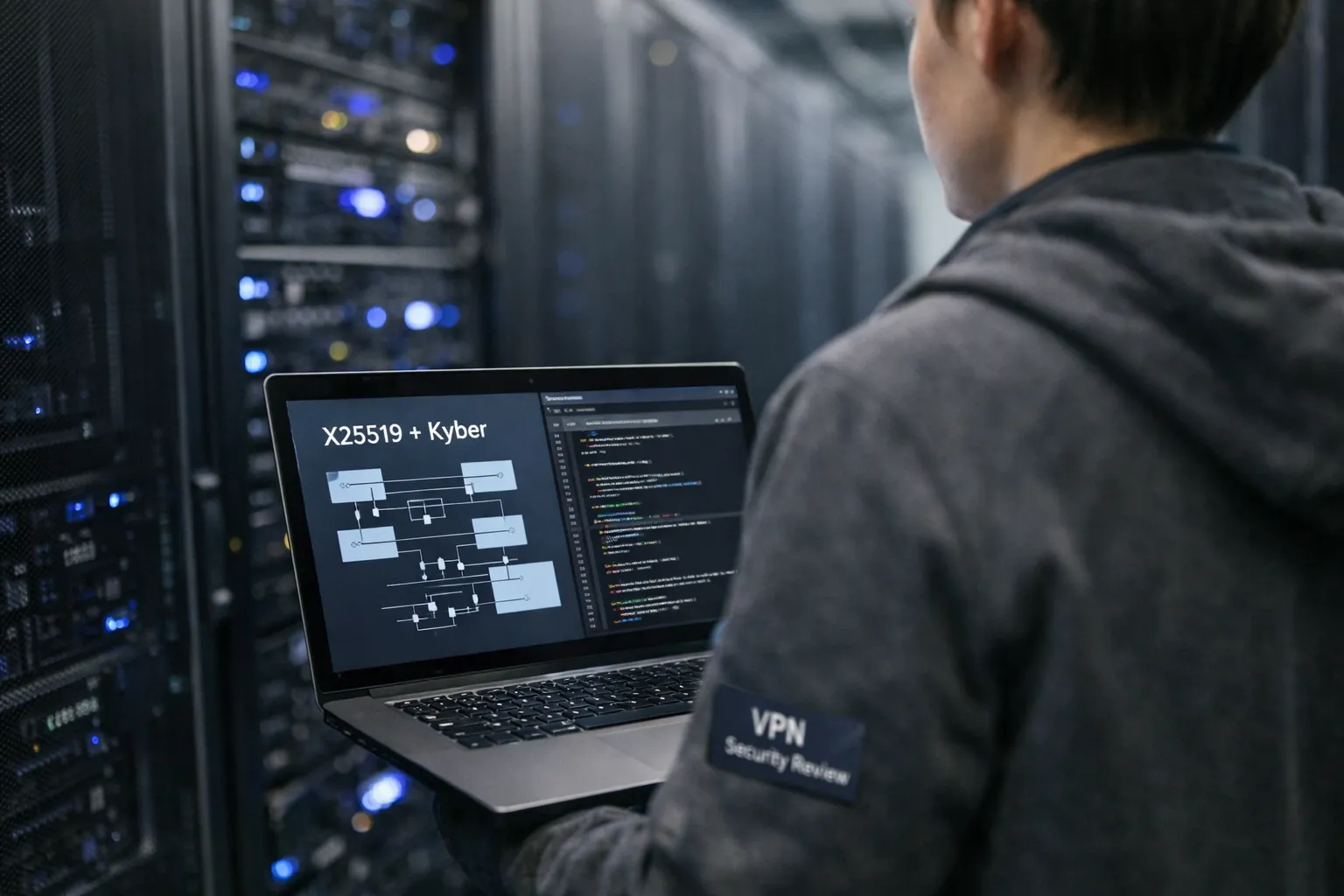
As the quantum‑computing threat moves from theoretical to practical planning, VPN operators and privacy‑conscious users face a concrete engineering choice: how and when to harden VPN tunnels against future quantum adversaries. In 2026 the industry has settled on a pragmatic intermediate approach — hybrid handshakes that combine classical and post‑quantum (PQC) primitives — but implementations vary widely. This article analyzes the technical trade‑offs, performance impact, deployment patterns, and operational recommendations for VPN services moving to post‑quantum readiness.
Why VPNs need post‑quantum planning now
The core risk driving PQC adoption is “store‑now, decrypt‑later.” Adversaries who can capture encrypted VPN traffic today may decrypt it years later when practical quantum advantage over current asymmetric cryptography exists. For organizations whose confidentiality requirements extend over years (legal discovery, research, journalism, corporate secrets), the cost of retroactive decryption is unacceptable.
VPN traffic also often carries metadata and session context that lengthen sensitivity windows. While symmetric cryptography is already quantum‑resistant when keys are sufficiently long, asymmetric key exchange and signatures that establish session keys are vulnerable — so the handshake is the principal focus for PQC hardening.
Two mainstream migration strategies
VPN vendors are pursuing a small set of practical strategies rather than radical protocol redesigns:
- Hybrid KEM handshakes: Combine a classical ephemeral Diffie‑Hellman (e.g., X25519) with a post‑quantum key‑encapsulation mechanism (KEM) such as CRYSTALS‑Kyber. The resulting session key is derived from both inputs, providing resistance against quantum adversaries even if one primitive is broken later.
- PQC for signatures and certificates (emergent): Move CA and server signatures to PQC algorithms or hybrid signature schemes. This complements hybrid KEMs but depends on CA ecosystem readiness; uptake here is slower.
Why hybrid KEMs are dominant
Hybrid KEMs provide the best balance of immediate protection and interoperability. They require relatively modest protocol changes for TLS‑based VPNs (OpenVPN, SSTP, TLS tunnels) where TLS 1.3 ciphersuites can be expanded. For non‑TLS tunnels—most notably WireGuard, which uses the Noise framework—implementations typically add a hybrid KEX step or piggyback a PQ pre‑shared secret process.
Implementation realities: what providers are doing in 2026
By mid‑2026 many providers have rolled out opt‑in PQ modes or experimental endpoints. Key enablers are open‑source projects and libraries such as the Open Quantum Safe project (liboqs), and upstream support in TLS stacks and crypto libraries. Cloud providers and CDN operators ran public PQ tests years earlier; those experiments informed VPN vendors’ choices.
Implementation choices cluster along several axes:
- Which PQ algorithms: Following NIST’s earlier selections, many implementations standardize on KEMs like Kyber (various security levels) for key exchange, pairing it with classical X25519 in hybrids. For signatures, CRYSTALS‑Dilithium or alternatives are used in experimental deployments.
- Handshake frequency: Protocols with infrequent handshakes (persistent WireGuard peers) pay the handshake cost once per rekey, making PQ overhead negligible for long‑running tunnels. TLS‑based VPNs that renegotiate often face higher aggregate overhead.
- Client coverage and opt‑in modes: Most real‑world rollouts started as opt‑in modes for newer clients while keeping classical fallbacks for legacy devices.
Performance and operational trade‑offs
Post‑quantum primitives change resource use in three ways: CPU cycles during handshake, larger handshake payloads, and increased memory or stack usage for certain algorithms. The result is measurable but manageable.
- Handshake latency and CPU: On modern x86 servers with SIMD acceleration (AVX2/AVX512), Kyber’s additional cost is typically on the order of a few milliseconds for the key‑encapsulation operations — a modest increase compared with network RTT in WAN environments. On low‑power ARM devices (mobile phones, embedded routers), the overhead can rise to tens of milliseconds without optimized libraries or hardware acceleration. For high‑connection‑rate servers that perform many handshakes per second, the aggregate CPU cost matters and must be benchmarked.
- Payload size and MTU: PQ KEMs and signatures produce larger public keys and ciphertexts than classical elliptic curves. That increases initial handshake packet sizes and raises the risk of IP fragmentation on UDP‑based VPNs. Providers must test MTU behavior, adjust fragmentation handling, and consider using encapsulation strategies or path MTU discovery for robustness.
- Throughput after handshake: Once a symmetric session key is derived, steady‑state throughput is unaffected; PQC costs are concentrated in the handshake. Thus for long‑lived tunnels, the performance impact is tiny.
Interoperability and compatibility challenges
Several practical interoperability issues slow rollouts:
- Client diversity: Rolling out PQ modes requires client updates across platforms—Windows, macOS, Linux, iOS, Android, and embedded routers. Mobile OS restrictions (background processing, CPU limits) make vendor coordination essential.
- Middleboxes and UDP fragmentation: Larger handshake packets are more likely to be dropped or blocked by stateful NATs and middleboxes that assume small UDP packets. Testing in the wild is necessary.
- CA and PKI readiness: PQ signatures for certificates are still emerging in the public CA ecosystem. As a result, many deployments use classical certificate chains with hybrid KEM handshakes, which secures session keys even if certificates remain classical.
Threat modeling: when PQC matters for VPN users
Adopting PQC is most urgent when the confidentiality horizon extends beyond the expected lifetime of current public‑key cryptography. Typical high‑priority use cases include:
- Corporate IP and R&D that must remain secret for many years;
- Journalists, activists, and legal counsel who require long‑term confidentiality;
- Government and critical infrastructure communications where nation‑state adversaries might harvest traffic now for future decryption.
For casual users whose threat model counts on short‑term confidentiality, PQC is less urgent — though opt‑in hybrid modes provide low cost insurance.
Practical recommendations for VPN providers
Based on current implementations and field experience, here are actionable steps for operators and advanced users:
- Implement hybrid KEMs first: Add hybrid X25519+Kyber handshakes as an opt‑in mode to reduce compatibility friction. This yields immediate protection against store‑now, decrypt‑later attacks.
- Benchmark across your client base: Test handshake latency and CPU cost on representative devices (older Android phones, consumer routers, server instances). Use AVX/NEON optimized PQ libraries where available.
- Watch MTU and fragmentation: Ensure your UDP paths and clients handle larger handshake packets robustly. Where fragmentation is an issue, provide TCP‑fallback endpoints or adjust encapsulation.
- Offer transparent opt‑in and logs: Publish opt‑in endpoints and adoption metrics, and explain the fallback behavior. Users should be able to choose PQ mode without losing access for legacy clients.
- Audit PQ libraries and update supply chain: PQC implementations are still maturing. Prefer well‑maintained libraries (liboqs and vetted downstream integrations), monitor CVEs, and plan timely updates.
- Plan for certificate migration: Engage with CA partners about PQ signing and prepare for hybrid certificate schemes when the ecosystem supports them reliably.
Recommendations for advanced users and VPN enthusiasts
If long‑term secrecy matters to you, prefer providers that:
- Publish an explicit PQ roadmap and provide hybrid KEM endpoints;
- Document performance trade‑offs and allow client‑side testing modes;
- Follow best practices for key rotation and ephemeral keys;
- Use audited PQ implementations and publish transparency reports on adoption.
Conclusion
Post‑quantum readiness for VPNs in 2026 is a pragmatic, incremental journey rather than a switch‑flip. Hybrid handshakes are the practical first step: they deliver forward secrecy against future quantum adversaries with manageable performance and interoperability costs. Vendors that plan carefully — benchmarking device performance, addressing MTU and fragmentation, and offering opt‑in modes — can protect long‑lived confidentiality without disrupting today's users. For organizations with high confidentiality needs, moving to hybrid PQ modes now is a sensible hedge against a future in which quantum computers threaten classical asymmetric cryptography.