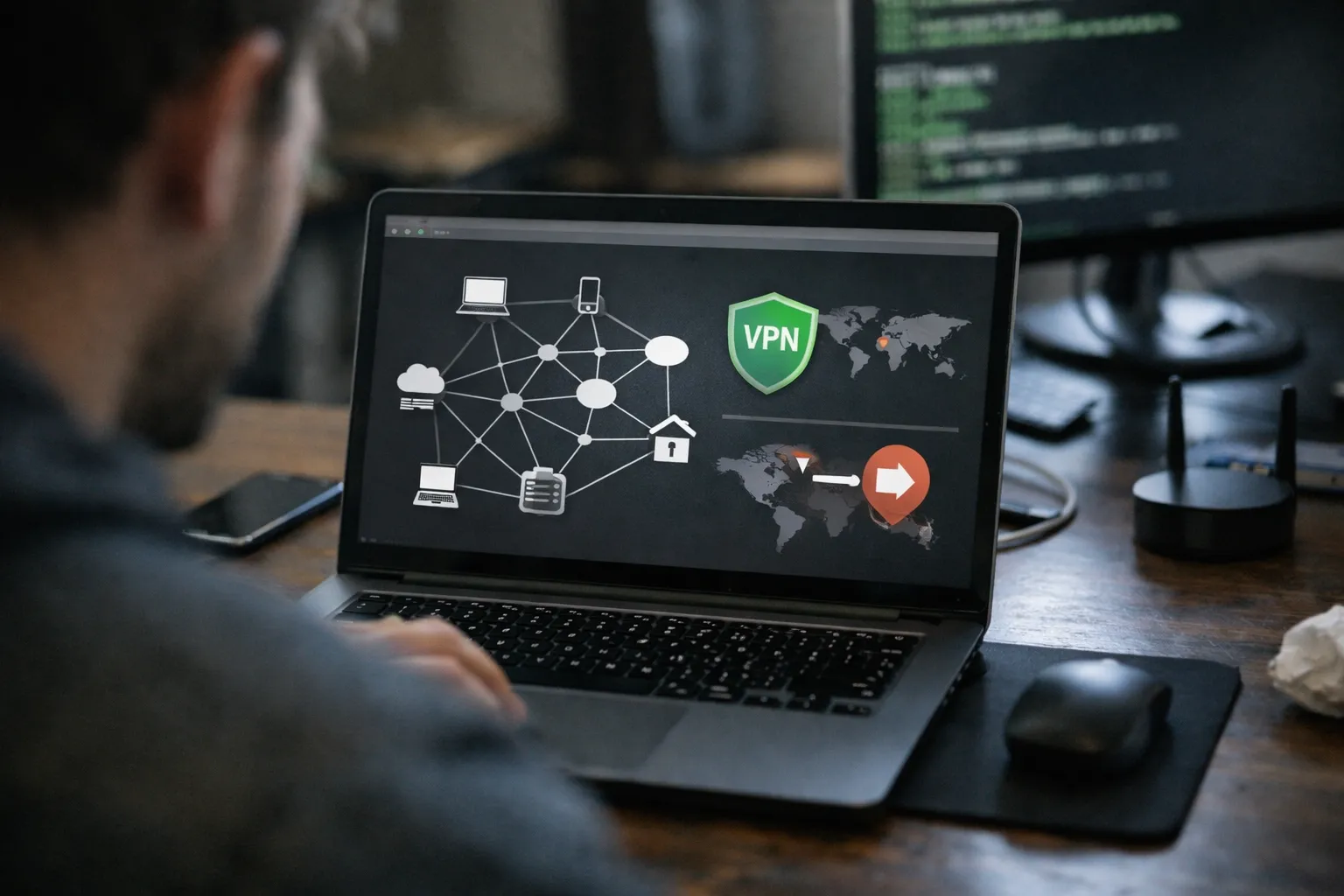
Summary: Tailscale remains a WireGuard‑based mesh VPN and zero‑trust connectivity platform focused on identity‑first access rather than anonymous browsing. This September 2026 update examines what’s changed in the last year, how the product behaves in real deployments, new operational best practices, and precisely when Tailscale is — and isn’t — the right tool for VPN enthusiasts and small teams.
Overview: What we’re reviewing
Tailscale creates private networks (tailnets) by orchestrating WireGuard tunnels between devices. It uses a hosted control plane for key exchange, coordination, ACLs and device identity; the data plane is end‑to‑end WireGuard. Key capabilities remain: peer‑to‑peer tunnels, DERP relays for traversal, exit node support, MagicDNS, Tailscale SSH, subnet routing, and programmatic ACLs.
- Transport: WireGuard tunnels (end‑to‑end encryption).
- Traversal: Direct mesh first, DERP relays when NAT or firewalls block peers.
- Exit nodes: Any tailnet device can be configured to forward Internet egress.
- Discovery: MagicDNS, device names and advertised routes.
- Access control: SSO integration, ACLs expressed as JSON/YAML, device tags.
- Open components: Clients and many tools are open source; control plane is managed by Tailscale.
Background: Who makes this and who it targets
Tailscale Inc. builds the service. The product targets engineers, system administrators, small-to-medium teams, hobbyists running home labs, and organisations adopting zero‑trust principles without heavy ops overhead. It is explicitly not a consumer anonymity service; instead it prioritizes device identity, simple network automation and secure remote access.
Features analysis — what’s new and what matters in 9/2026
Since mid‑2025, development has emphasized enterprise scale, developer ergonomics and integrations rather than shifting the product toward anonymous Internet browsing. Notable themes through September 2026:
- Stronger enterprise tooling: Improvements to audit logging, org‑level device policies and integrations with common MDM/IDP providers. These make regulatory deployments (SOC2, ISO) easier to manage without full self‑hosting.
- Automation and infrastructure integrations: Broader Terraform/Ops tooling and matured Docker/container workflows in community repos simplify deploying subnet routers and exit nodes in cloud VMs for controlled egress.
- Device security hardening: Expanded options for device attestation and conditional access (OS patch status, MDM posture checks) that integrate with SSO signals.
- Community and ecosystem: More published examples for running scalable exit nodes (multi‑AZ cloud VMs, autoscaling NAT gateways combined with Tailscale), plus prebuilt images and Ansible roles from the community.
Core technical facts remain unchanged: the control plane coordinates keys but cannot decrypt WireGuard data. Trade‑offs around control‑plane metadata exposure are still the central privacy consideration.
Hands‑on: Performance & reliability (current practical guidance)
In direct peer connections, WireGuard continues to deliver very low CPU overhead and sub‑10ms extra latency on LANs and modest overhead over WAN compared with baseline IP routing. Real‑world observations in 2026 deployments show:
- SSH, RDP and file transfers are generally indistinguishable from plain IP links when peers connect directly.
- When DERP relays are used, expect added latency (commonly 20–150 ms depending on region and relay topology) and throughput reduction; the impact depends on relay hop counts and relay capacity.
- Exit node performance is constrained by the host’s uplink. For streaming or heavy downloads, place exit nodes in cloud VMs with 1 Gbps+ egress and appropriate firewall rules rather than on typical home broadband.
- Mobile and roaming reliability remains strong: sessions rekey and recover automatically, though cellular networks and captive portals are still common friction points.
Privacy, threat model and control plane trade‑offs
Tailscale’s identity‑centred model gives operational convenience and strong cryptography, but it inherently collects control‑plane metadata:
- The control plane knows tailnet membership, device identifiers, advertised routes and connection attempts.
- That metadata can be material for threat models concerned with traffic patterns, device inventory leakage, or law‑enforcement requests — even though the control plane cannot decrypt WireGuard payloads.
Practical mitigations in 2026:
- Use enterprise contracts and data‑processing agreements if regulatory controls are required; Tailscale publishes compliance aids and support for data residency options in paid plans.
- Run self‑managed exit nodes or cloud‑based egress appliances for privacy‑sensitive web access; do not assume Tailscale protects you from cross‑site trackers or third‑party correlation.
- Segment tailnets and apply tight ACLs and device tags to limit unnecessary visibility inside an organization.
Security features and auditability
Tailscale’s security posture continues to rest on short‑lived WireGuard keys, SSO integration, and device‑level attestation. The open release of client code improves auditability for the data plane. For stricter requirements, the company’s enterprise offerings provide additional logging, role‑based admin controls, and the option to reduce some metadata exposure via organizational controls — though fully eliminating hosted control‑plane signals typically requires alternative self‑host architectures.
Usability: setup and daily operation
Setup still ranges from trivial (single‑command install on desktop/mobile) to straightforward automation for servers. MagicDNS and service advertisement remain the standout usability features. For teams, the path from “laptop to server to subnet router” is now better documented with more community templates and official examples for cloud exit nodes and autoscaled relay setups.
Operational best practices updated for 9/2026:
- Use device tags and ACLs as code stored in version control to standardize access rules across teams.
- Prefer cloud exit nodes with explicit NAT/firewall controls for heavy egress use cases; monitor egress costs.
- Enable device posture checks and short session durations where possible — especially for contractors or BYOD devices.
Pros and cons (updated)
- Pros: Low overhead WireGuard mesh, excellent for secure device‑to‑device access, improved enterprise controls and automation integrations, strong usability with MagicDNS and Tailscale SSH.
- Cons: Hosted control plane retains metadata; DERP relays add latency under certain network conditions; not a turnkey anonymous browsing or streaming bypass solution unless you control exit infrastructure.
Pricing and value (Sept 2026)
Tailscale continues to offer a free personal tier for casual use and multiple paid tiers for teams and enterprises that add device limits, audit logs, advanced admin controls and priority support. For heavy enterprise or compliance use, factor in the cost of enterprise plans plus any cloud egress charges for self‑run exit nodes. For hobbyists, running a small cloud VM as an exit node can cost roughly $5–$20/month depending on provider and bandwidth needs; for production streaming or heavy downloads, budget for higher‑tier cloud instances.
Who it’s for
Use Tailscale if you want:
- Simple, secure remote access between your devices, home lab or team services without managing complex VPN servers.
- Identity‑first access (SSO) and programmatic ACLs for developer and ops workflows.
- An easy replacement for ad‑hoc site‑to‑site VPNs in small distributed teams.
Avoid relying on Tailscale as your primary privacy tool if your main goals are anonymous browsing or consistent geo‑unblocking across many services — run and control your own exit nodes or use a purpose‑built VPN provider for those needs.
Alternatives
- WireGuard + self‑managed coordination (e.g., headscale): For teams that need a fully self‑hosted control plane to eliminate managed metadata. Requires more ops work.
- Commercial consumer VPNs (Proton, Nord): Better suited to anonymous browsing and streaming unblocking; do not provide the same identity‑centric mesh for device‑to‑device access.
- ZeroTier: Similar mesh model with different trade‑offs around centralization and protocol design; consider for hybrid use cases.
Verdict
As of September 2026, Tailscale remains a leading practical choice for identity‑centric private networking. Its WireGuard mesh, MagicDNS convenience, and maturing enterprise features make it the default pick for engineers, small teams and hobbyists who need reliable remote access and tidy access controls. The principal caveat continues to be the hosted control plane: if your threat model is sensitive to control‑plane metadata, you must either accept that trade‑off under enterprise contracts or use self‑hosted alternatives for coordination.
Bottom line: For device‑to‑device connectivity, developer workflows, and zero‑trust team access in 2026, Tailscale is frequently the fastest, simplest and most operationally efficient choice — provided you explicitly manage exit‑node placement and understand the control‑plane privacy trade‑offs.
FAQ
Can Tailscale be used for anonymous browsing?
No. Tailscale’s design is for authenticated device‑to‑device access. You can mask your IP by routing traffic through an exit node you control, but Tailscale is not an anonymity network and does not prevent tracking across unrelated web services.
Does Tailscale see my traffic?
No—Tailscale’s control plane coordinates keys and connections but cannot decrypt WireGuard payloads. However, the control plane does see metadata: device membership, advertised routes and connection attempts.
Should enterprises self‑host the control plane?
Most organisations gain efficiency from the hosted control plane plus enterprise contracts and controls. Self‑hosting (using alternatives) removes hosted metadata at the cost of operational complexity. Choose based on your compliance, legal and threat‑model requirements.
How do I improve exit‑node performance for streaming or heavy downloads?
Run exit nodes on cloud VMs with high egress capacity in the region closest to your users, limit NAT and firewall bottlenecks, and monitor bandwidth costs. Avoid using home broadband for heavy egress workloads.
Is DERP still necessary?
Yes. DERP relays remain a practical fallback for NAT and firewall traversal. You should design for performance variance when DERP is used — direct WireGuard links remain preferable where possible.