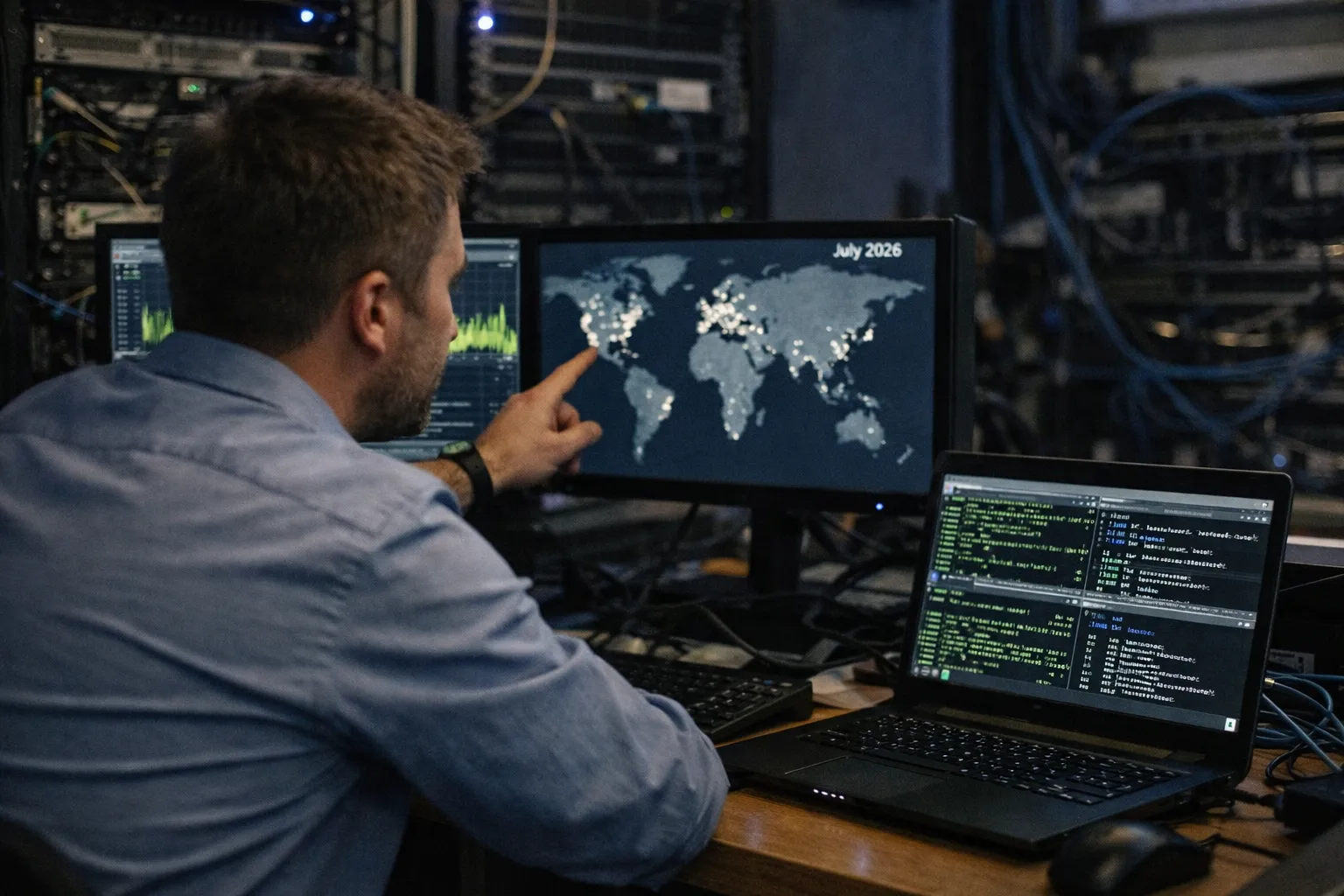
In 2026 the contest between VPN providers and network-level detectors has moved decisively into machine learning. Deep packet inspection (DPI) systems, TLS/TCP fingerprinting, and flow-based ML models now work together at Internet exchange points and ISP backbones to classify encrypted traffic with high accuracy. VPN services have pushed back with a mix of transport obfuscation, TLS mimicry, QUIC-based transports, and adaptive padding. This article analyzes current detection methods, VPN countermeasures, real-world trade-offs, and practical testing approaches VPN enthusiasts and engineers should know.
What modern detectors look for
Detectors no longer rely on simple port or byte-pattern checks. Typical ML-enhanced detection pipelines in 2026 combine several signal classes:
- TLS/cryptographic fingerprints: JA3/JA3S and JARM-style fingerprints capture TLS handshake parameters, cipher lists, and extensions. Even encrypted handshakes leak deterministic features that ML classifiers use.
- Flow-level features: Packet sizes, inter-packet arrival times, direction ratios, burst patterns, and connection duration are summarized into feature vectors for time-series models.
- Statistical entropy and payload heuristics: Encrypted payload entropy and header anomalies (e.g., constant-length frames) help separate application-layer protocols.
- Contextual signals: IP reputation, AS ownership (data-center vs residential), hosting provider tags, and historical behavior feed into ensemble classifiers.
Combined, these signals allow gradient-boosted trees or lightweight neural networks to flag likely VPN flows with much lower false-positive rates than older DPI. In censoring environments, models are tuned for recall at the cost of some collateral blocking.
How VPNs are responding
VPN vendors and open-source projects have developed layered countermeasures. Key approaches in use today:
- TLS mimicry (uTLS and client mimicry): Libraries such as uTLS allow clients to emulate popular browser TLS fingerprints, changing JA3 signatures to look like Chrome, Safari, or mobile browsers. This reduces the effectiveness of static JA3-based rules.
- Transport over QUIC/HTTP/3: QUIC's encrypted headers and multiplexing make flow features noisier and harder to classify. Several VPN projects now experiment with WireGuard or custom tunnels carried over HTTP/3 to leverage browser-like characteristics.
- Obfuscation layers (obfs4, meek-style proxies): Obfs proxies randomize handshake packets or encapsulate VPN flows in innocuous HTTPS requests. While domain fronting has largely disappeared on major CDNs, proxy chains and CDN-backed relays remain practical in some jurisdictions.
- Adaptive padding and timing randomization: Adding variable padding to packets and jittering send times disrupts flow-level signatures, though it increases overhead and may reduce throughput.
- Ephemeral egress infrastructure and residential proxies: Rotating egress IPs and using residential-addressed relays make AS-based heuristics and IP-reputation signals less reliable. This practice increases cost and operational complexity.
Effectiveness vs. cost
Not every obfuscation strategy is suitable for all users. The main trade-offs are:
- Performance: QUIC and TLS mimicry preserve throughput better than heavy padding, which increases overhead and latency. Obfuscation that requires proxy relays or double encapsulation often reduces throughput and increases latency.
- Battery and CPU: Mobile clients pay a battery tax for CPU-intensive obfuscation and frequent cryptographic operations. Kernel-mode implementations (e.g., WireGuard in-kernel) remain more efficient than userland proxies, but are harder to obfuscate without extra encapsulation.
- Operational complexity and cost: Rotating residential relays and CDNs cost more and complicate compliance; heavy use of cloud VMs can provoke blocks from content providers and higher scrutiny from cloud providers.
- Detectability arms race: Any newly deployed evasion will eventually be profiled and fed back into ML training datasets, reducing long-term effectiveness.
Market and regulatory dynamics
The detection arms race influences market behavior and provider strategy:
- Differentiation by anti-censorship capability: Providers that support multiple obfuscation transports and rapid protocol updates have gained traction in censorship-prone markets. These are often offered as premium tiers due to higher infrastructure costs.
- Enterprise SASE and TLS inspection: Widespread adoption of Secure Access Service Edge (SASE) in enterprises means many corporate VPN use-cases are subject to enterprise TLS inspection appliances that intentionally intercept TLS. That trend makes client-side obfuscation less relevant in enterprise settings and raises legal/compliance implications.
- Cloud provider policy and content blocks: Because many VPN operators use cloud-hosted exit nodes, CDNs and content owners increasingly use data-center IP lists and ML classifiers to block streaming/unwanted traffic. That drives some providers toward hybrid models that mix cloud and physically rented or colocated servers.
How to evaluate whether your VPN is being detected
For technically inclined users and reviewers, practical tests will reveal where detection is happening and which mitigations work.
- Baseline capture: Collect pcaps on client and server sides (tcpdump, Wireshark). Ensure captures include full handshakes.
- Fingerprint analysis: Run JA3/JA3S and JARM on TLS handshakes; compare fingerprints across transports. Tools: JA3 utilities, JARM scanner, Zeek scripts.
- Flow-feature comparison: Extract flow statistics (packet sizes, inter-arrival times) with Zeek or tshark. Train a small classifier or compare to known benign app flows (e.g., browser HTTPS) to see separability.
- Throughput/latency tests with and without obfuscation: Measure real-world throughput and pings using iperf3 and HTTP speed tests. Note CPU usage and battery impact on mobile clients.
- Real-world validation: Test in target networks (home ISP, mobile carrier, and, where legal and ethical, censorship-prone networks). Observe connection drops, forced resets, or active block pages.
Practical recommendations for VPN users and enthusiasts
- Choose providers that offer multiple transport options (WireGuard, OpenVPN, WireGuard-over-QUIC, TLS-mimic). Protocol flexibility increases resilience.
- Prefer providers with open-source clients or audited obfuscation stacks so you can inspect TLS mimicry and obfs implementations.
- On mobile, test battery impact and prefer kernel-mode tunnels when obfuscation is unnecessary. Use obfuscation only when needed because of its CPU and latency costs.
- If you rely on VPNs for anti-censorship, use layered approaches: transport mimicry + port rotation + fallback proxies. No single method is permanently effective.
- Run your own measurement checks (JA3, flow features, speed tests) periodically after updates—both client- and server-side changes can alter detectability.
Where this arms race is headed
Expect a continuous cat-and-mouse dynamic. Over time detectors will move toward temporal models that learn new fingerprints automatically; VPNs will increasingly lean on genuine application-layer encapsulation (e.g., legitimate browser stacks, in-app tunnels) and on distribution of egress diversity. Regulators and cloud providers will exert influence: tightening acceptable-use policies can limit some evasion tactics, while privacy-focused jurisdictions may incentivize more resilient architectures.
For VPN service enthusiasts and operators, the practical takeaway is clear: diversify transports, measure continuously, and weigh obfuscation gains against performance and cost. The ML-enhanced detection era rewards agility and transparent engineering over single-point “silver-bullet” solutions.